
Choosing the right PVC foam board thickness is not simply a matter of selecting 3 mm, 5 mm, 8 mm, or 10 mm. A suitable specification depends on what the display will hold, the size of its panels, the location of its supports, and the properties of the selected board.
A compact cosmetics display and a hardware display may look similar, but the merchandise can create very different loading conditions. The same is true when comparing shampoo bottles, folded apparel, packaged snacks, and electronic accessories.
Quick answer: Start with the filled weight and quantity of the products. Define shelf spans and support positions. Identify which panels are decorative and which carry loads. Then compare board grade, thickness, connection details, and sample-test results. A thicker board does not automatically make the finished display stronger or safer.
1. How to Choose the Right PVC Foam Board Thickness
The starting point is the complete display design, not a thickness number from a sheet catalogue. Rigid expanded PVC foam board is a cellular PVC sheet material used in signage and fabricated retail displays. It is different from paper-faced foam board, corrugated cardboard, fluted polypropylene, and solid rigid PVC sheets.
Before selecting a material specification, establish five things:
- Merchandise: the filled weight, package dimensions, and quantity per shelf or hook.
- Dimensions: total display height, shelf width and depth, and the largest unsupported panel.
- Supports: how shelves, dividers, side panels, and bases connect and share loads.
- Board properties: actual grade, relevant mechanical data, surface quality, and thickness tolerance.
- Use conditions: retail location, handling frequency, cleaning, intended duration, and shipping method.
For example, a header may only need to carry its own weight, while a shelf needs to support merchandise. These components do not necessarily require the same thickness. Treat any suggested thickness as a design starting point, to be confirmed through the actual material specifications and a representative sample.
2. Common PVC Foam Board Thickness Options
Suppliers offer different nominal thickness ranges, depending on the material series. The following comparison is intended for preliminary planning, not as an industry-wide structural standard or load-rating chart.
| Nominal Thickness | Components to Consider | What to Check |
|---|---|---|
| 3 mm | Small headers, printed overlays, supported graphic panels | Large panels may need backing; avoid assuming load-bearing suitability |
| 5 mm | Compact counter-display parts, printed side panels, dividers | Panel span, connection method, and whether the part supports shelves |
| 6 mm | Selected partitions, side panels, compact structural parts | Grade, actual dimensions, and support configuration |
| 8 mm | Larger panels and selected supported shelving | Shelf depth, unsupported width, load distribution, and joint design |
| 10 mm | Selected bases, supports, shelving, and larger structural panels | Structural layout and material properties; thickness alone is insufficient |
| 12 mm and above | Particular thicker components where available | Extra material, fabrication, transportation weight, and actual need |
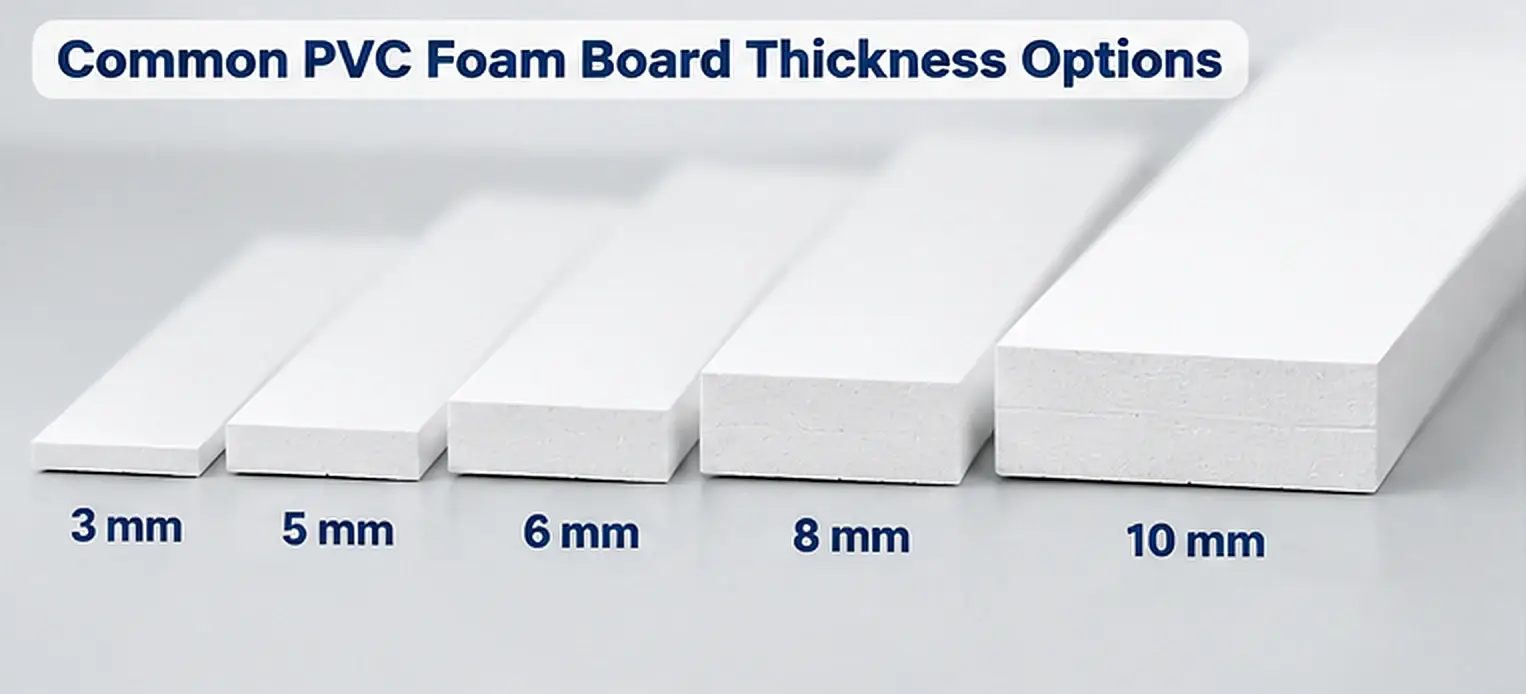
A 3 mm board may work well as a properly supported printed header, but the same board should not be assumed suitable for a wide merchandise shelf. A 5 mm board may be practical for selected compact panels. 8–10 mm boards may be considered for larger or more structural parts, but the dimensions and loading still decide whether a proposed configuration works.
Keep availability in mind: not every supplier stocks every thickness in every grade. Confirm the sheet specification before releasing cutting drawings.
3. Choosing Thickness for Different Display Components
A custom display often works better when the material specification follows the job of each component.
Headers and Printed Graphic Panels
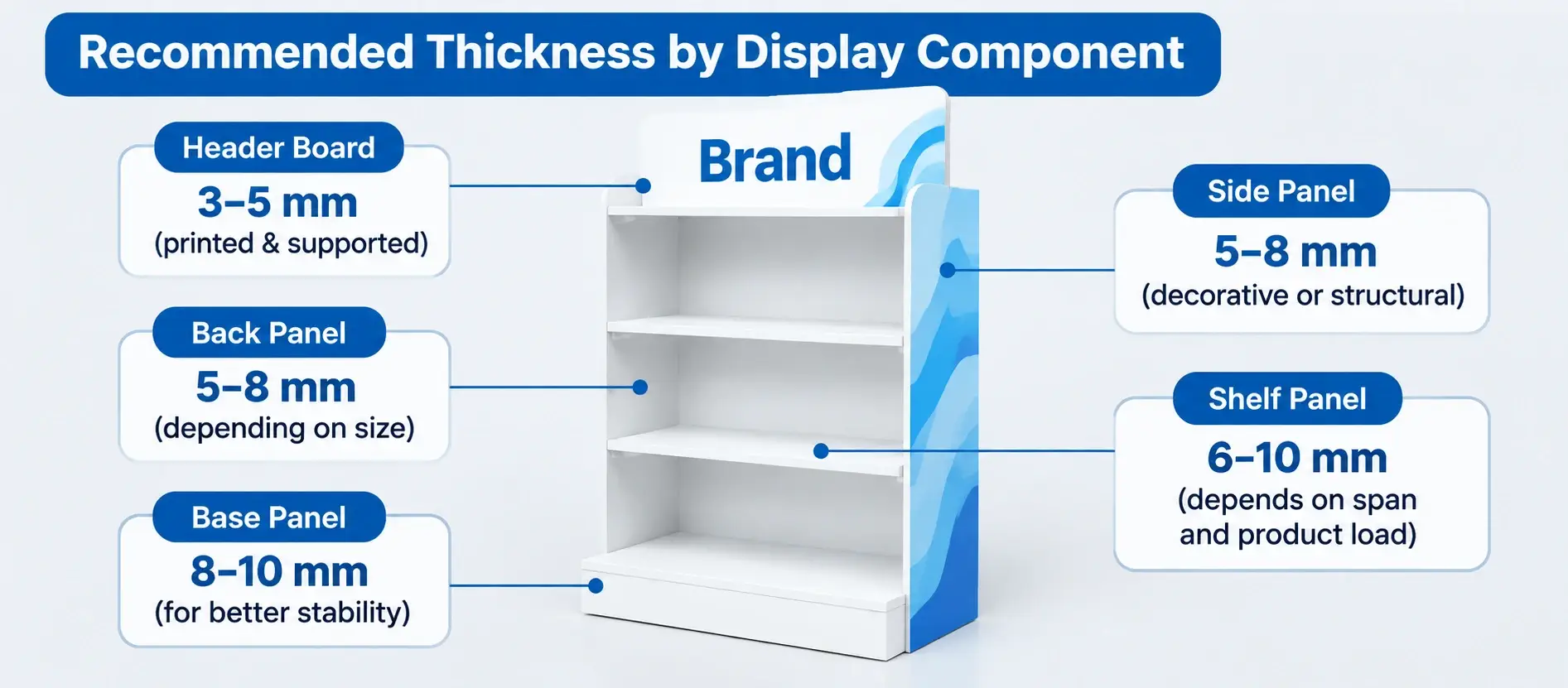
Headers communicate branding, product information, and promotional offers. Smaller, well-supported headers may use relatively thin board. Large shaped headers need a review of their outline, fixing points, and resistance to bending.
Side and Back Panels
Some side panels are primarily printed covers; others carry shelves and stabilize the entire unit. The same visible panel size can call for different material specifications depending on its structural role.
Shelves and Internal Dividers
Shelves directly support products. Choose their thickness and support method together, considering shelf width, depth, load distribution, and connections. Internal dividers can shorten unsupported spans, but only when designed to carry the relevant loads.
Bases and Peg Hook Areas
A floor display’s stability depends on its proportions, loading, and base footprint—not merely a thick bottom panel. For peg hook displays, loads are concentrated near mounting openings. Hook type, slot geometry, reinforcement, and surrounding panel material all need evaluation.
Practical principle: Do not increase every panel to the same thick grade when only a few components need additional structural support.
4. How Shelf Span and Support Design Affect Thickness
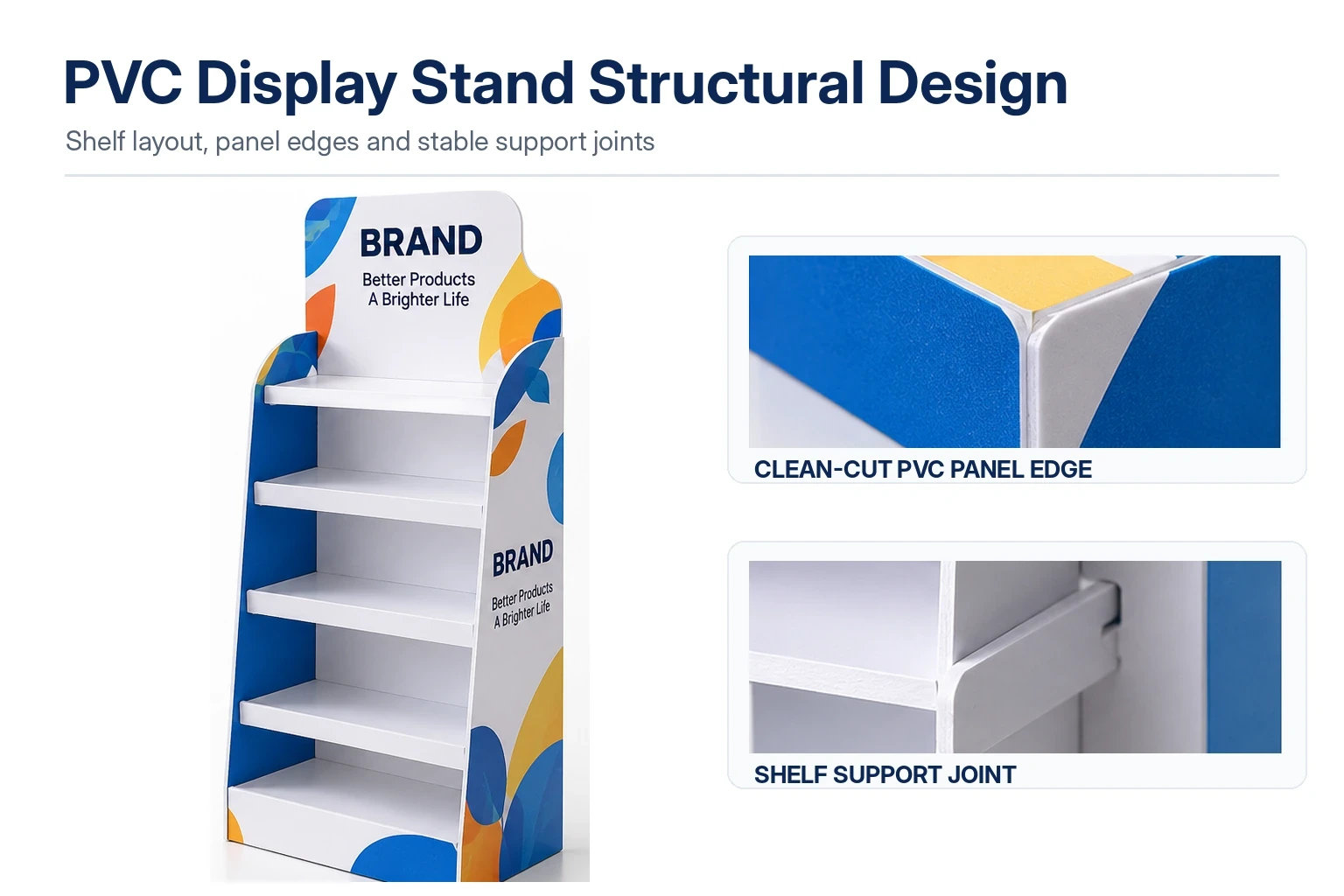
Two shelves made from the same nominal PVC sheet may perform differently. A narrow shelf supported along several edges and a wide shelf with a long unsupported front edge do not experience identical bending conditions.
As the unsupported span increases, shelf deflection may become more significant. Actual performance depends on the material’s stiffness, panel geometry, support conditions, and how merchandise is distributed.
Rather than automatically selecting thicker sheet, a designer can consider:
- Adding a central support or vertical partition.
- Reducing an excessively wide shelf span.
- Improving the way the shelf connects to side and back panels.
- Redistributing dense merchandise or changing shelf depth.
- Revising the support geometry or using a more appropriate material.
Consider a personal care display carrying filled body-wash bottles. An intermediate support may be more useful than increasing every external panel’s thickness. A hardware display with dense metal fittings may require changes to the overall structural arrangement.
Thickness is one variable in a structural system; it is not a substitute for structural evaluation.
5. Why Material Grade and Density Matter
Not every PVC foam board of the same thickness has identical properties. Material series can differ in density, cellular structure, surface quality, stiffness, strength, dimensional tolerance, and recommended fabrication methods.
Density is not the same as thickness. A heavier board is not automatically the right board for every application. A print-oriented panel and a load-carrying part may prioritize different material characteristics.
For an informed material decision, request the relevant technical data sheet and confirm:
- Nominal thickness and stated tolerance.
- Material grade and density, when specified.
- Mechanical properties relevant to the proposed display.
- Surface finish and compatibility with the planned printing method.
- Recommended cutting, routing, joining, and fabrication practices.
- Environmental limitations for the intended retail location.
Manufacturer data sheets for PVC foam sheet ranges such as FOREX or PALIGHT can provide general material reference points. They should not be treated as proof of the performance of an unrelated board grade or finished stand.
6. PVC Foam Board Thickness by Retail Industry
A useful material recommendation has to match the products on display. Select your industry below to jump straight to its main thickness and structural considerations.
Cosmetics & Beauty Displays
Typical products: lipstick, makeup palettes, skincare jars, foundation, serums, and perfume.
Cosmetics displays often prioritize clean printed surfaces, visual presentation, and precise cutouts. The weight difference between a lightweight makeup palette and several filled glass perfume bottles is substantial, even if both appear in similarly sized displays.
For small graphics and supported decorative parts, thinner board may be considered. Shelves holding glass jars or perfume bottles should be specified separately, with attention to their actual filled weight, span, and support arrangement. Shaped headers also need appropriate mounting points so they maintain their intended outline.
What to confirm: the largest filled product, number of units per shelf, cutout dimensions, print finish, and restocking access.
Buying tip: A beauty display can use thin printed panels and different shelf/support specifications within the same unit.
Personal Care Displays
Typical products: shampoo, conditioner, shower gel, body lotion, hand soap, toothpaste, and deodorant.
A personal care display may hold many bottles of similar dimensions. Individual containers can appear manageable, but the combined weight of a fully stocked shelf is what matters for the design. Larger bottles also affect shelf depth and product retention.
Rather than prescribing 5 mm or 10 mm for every personal care unit, review the filled weight per row, the unsupported shelf span, and whether a central partition is needed. PVC foam board offers useful moisture resistance, but inks, finishes, adhesives, and joints need their own assessment for cleaning or leakage exposure.
What to confirm: filled bottle weight, shelf count, depth, front retaining edges, and planned cleaning conditions.
Buying tip: Use the heaviest realistic shelf loading during sample evaluation, not empty display bottles.
Household & Cleaning Product Displays
Typical products: household cleaners, laundry products, paper goods, cleaning accessories, and daily necessities.
This category ranges from lightweight tissue packages to dense liquid containers. A board choice appropriate for paper goods may not work for a stand carrying large detergent bottles.
For light products, the design may prioritize efficient printing areas and easy customer access. For heavy liquids, the focus shifts toward shelf support, connection strength, and base stability. Consider whether the unit will be moved while stocked and whether cleaning chemicals may contact printed or joined surfaces.
What to confirm: filled weight, quantity per shelf, movement during use, and any expected liquid exposure.
Buying tip: Divide mixed household-product ranges into groups with similar structural requirements before requesting a specification.
Hardware & Industrial Accessories
Typical products: fasteners, bolts, plumbing fittings, measuring accessories, small tools, and boxed industrial components.
Small packages can contain surprisingly dense merchandise. A shallow shelf of metal fittings may carry much more weight than a similarly sized shelf of personal care accessories. Hanging packs also place localized forces around peg hook slots.
Selected thicker panels, shorter shelf spans, reinforcement, or a different connection design may be needed. For substantial loads, a non-PVC or mixed-material structure might be more appropriate. Nominal board thickness by itself cannot establish hook capacity or finished-display load capacity.
What to confirm: maximum merchandise load, package concentration, hook type, fixing geometry, and expected customer handling.
Buying tip: Load-test a sample with representative dense products and the actual intended hook or shelf configuration.
Apparel & Fashion Accessories
Typical products: folded T-shirts, socks, caps, scarves, belts, and packaged clothing accessories.
Apparel products are often relatively light, but larger shelf widths and hanging arrangements can still create design challenges. A wide T-shirt shelf may need more support than a compact shelf holding the same total product weight. Socks and small accessories on hooks require attention to the mounting panel and repeat handling.
Supported graphic panels may permit a lighter specification, while wide shelves or heavily used hook areas need their own review. Replaceable campaign headers can help retailers refresh seasonal promotions without rebuilding the entire stand.
What to confirm: folded package dimensions, shelf width, hook layout, product access, and the frequency of promotional graphic changes.
Buying tip: Lightweight merchandise does not automatically mean an unsupported wide shelf can use thin board.
Food, Snacks & Beverage Displays
Typical products: packaged snacks, confectionery, gift packs, bottled drinks, jars, and multipacks.
Snack packets and filled beverage bottles differ greatly in weight and merchandising behavior. A small snack display may use compartments or shallow shelves, while a beverage unit requires stronger attention to shelf loading, retention edges, and base stability.
Evaluate the complete product mix, not only package dimensions. If using an open-bin structure, verify how the side walls and base connect. Do not assume that PVC foam board is approved for direct food contact without evaluating the actual grade and intended application.
What to confirm: filled bottle weight or package weight, units per shelf, product-retention requirements, and storage or cleaning conditions.
Buying tip: Ask for a structural review when moving from lightweight snack packages to bottled beverages or heavy multipacks.
Consumer Electronics & Mobile Accessories
Typical products: phone cases, chargers, cables, packaged adapters, and headphones.
These products often use peg hooks or compact shelves. In a hook display, repeated customer handling and forces concentrated near the mounting slot can matter more than the overall size of the stand.
The board, hook, hole geometry, support and fixing method should be chosen together. Larger printed back panels may need support to remain flat, while higher-value products may also require separate security or retention features.
What to confirm: hook type, maximum packaged products per hook, back-panel span, and handling frequency.
Buying tip: Include a sample hook and a real product pack in the design brief.
Pet Products & Accessories
Typical products: grooming items, packaged toys, collars, pet-care bottles, and small bags of accessories.
Pet products vary widely in density and package size. A hook display for collars may have modest overall loading but concentrated forces at the fixing points. A shelf holding multiple heavy bags may need a substantially different structure.
Select panel and support thicknesses from the actual product arrangement. Assess overall stability and whether customers may pull or handle bulky packs frequently.
What to confirm: product weight, package dimensions, distribution by shelf or hook, and expected customer interaction.
Buying tip: Do not select a common thickness for all pet merchandise solely because it belongs to the same retail category.

Quick Industry Comparison
| Industry | Product Characteristic | Main Thickness/Structure Priority |
|---|---|---|
| Cosmetics & Beauty | Light packs mixed with glass containers | Print quality, supported shelves, precise cutouts |
| Personal Care | Repeated rows of filled bottles | Shelf depth, combined load, intermediate supports |
| Household & Cleaning | Wide range from paper goods to liquids | Product-specific loads and base stability |
| Hardware & Industrial | Dense packs and hook-mounted parts | Concentrated loads, connections, reinforcement |
| Apparel & Fashion | Light merchandise, wider shelving or hooks | Shelf span, mounting support, replaceable graphics |
| Food & Beverages | Light snacks versus filled bottles | Shelf loading, retention, support and base |
| Consumer Electronics | Small packaged accessories, peg hooks | Hook slots, back-panel rigidity, handling |
| Pet Products | Mixed weights and package sizes | Actual shelf/hook distribution and stability |
There is no universal board thickness for a retail industry. The final specification follows the actual merchandise and proposed structure.
7. PVC Foam Board Thickness, CNC Cutting, and Assembly Fit
The nominal thickness printed on a board specification is not always the exact measured dimension of every sheet. Manufacturing tolerances and processing conditions matter, especially for slot-fit components.
A slot designed without checking the actual board may be too tight or too loose. This can affect assembly time, alignment, fit, and connection reliability. For interlocking displays, cutting drawings should reflect the selected material’s dimensional characteristics.
Review CNC cutting and assembly together:
- Confirm the actual board grade and thickness before finalizing cutting files.
- Verify slot clearance and the material remaining around openings.
- Check whether the joints can be assembled without damaging printed panels.
- Test panel alignment, shelf fit, and stability on a physical sample.
- Confirm the intended packing method does not compromise parts or surface finishes.
Buying tip: Approve the production cutting files only after sample assembly has been checked using the intended board specification.
8. How Thickness Affects PVC Display Project Cost
For comparable grades, thicker material generally uses more raw material for the same panel area. It may also affect fabrication, shipment weight, and structural connections. But the thinnest board is not always the lowest-cost finished solution.
A thin shelf that needs additional support, more complex joints, or repeated redesign may not offer the expected total savings. Conversely, increasing every component to a thicker board can add unnecessary weight and material consumption.
To compare designs fairly, review the complete bill of materials, support structure, printing, assembly, protective packaging, and transportation method. A mixed-thickness configuration may be appropriate when it meets the intended performance requirements.
For a broader discussion of pricing factors, see our custom PVC display stand cost guide.
9. What to Check Before Ordering PVC Display Stands
Confirming the right PVC foam board thickness before production helps buyers avoid unnecessary material costs and assembly issues. To receive a suitable material recommendation and accurate quotation, prepare the following project information:
- Product information: pack type, dimensions, actual filled weight, and units per shelf or hook.
- Display size: preferred overall width, depth, height, and space available in-store.
- Configuration: floor, counter, peg hook, or bin display; shelf or hook layout.
- Artwork: logo files, design references, printing surfaces, and finish preferences.
- Use conditions: expected duration, cleaning, customer handling, and whether the stand is moved when stocked.
- Order requirements: estimated quantity, target destination, and preferred packing method.

Sample Checks Before Bulk Production
A physical sample can reveal issues not obvious in a rendering or drawing. Review stability, shelf deflection under representative loading, joint fit, print quality, visible panel edges, assembly, and product accessibility.
For demanding applications, agree on appropriate loading and handling tests before bulk production. Do not use a generic thickness-to-weight claim in place of the proposed display’s own validation.
10. Frequently Asked Questions
What is the best PVC foam board thickness for retail display stands?
There is no single best value. The suitable grade and thickness depend on actual merchandise, panel dimensions, support arrangements, connection method, and retail conditions. A single stand may use several material specifications.
Can 5 mm PVC foam board be used for a countertop display?
It may suit selected compact printed parts, side panels, and supported components. Its suitability for shelves or other structural components must be evaluated in the complete design.
Is 10 mm PVC foam board strong enough for heavy merchandise?
A thicker board of comparable grade may provide greater stiffness, but that alone does not establish the load-bearing capacity of a finished display. Shelf spans, support geometry, connections, material properties, and sample testing remain necessary.
Is higher-density PVC foam board always better?
No. Density is one property, not a universal quality score. Compare mechanical properties, surface requirements, fabrication behavior, and the intended use before selecting a board grade.
Can different thicknesses be combined in one display?
Yes. Supported printed headers and load-carrying shelves often have different design requirements. A mixed specification can be considered if the connections and the full structure are validated.
Can PVC foam board displays be used in humid environments?
Rigid expanded PVC foam board generally offers useful moisture resistance. However, printing, joining methods, temperature, surface finishes, and the intended exposure must all be assessed. Moisture resistance alone does not mean every board grade is suitable outdoors.
Conclusion: Select Thickness as Part of the Whole Structure
Choosing PVC foam board thickness is a design decision, not simply a sheet-purchasing decision. A cosmetics display may prioritize a flawless printed surface; a personal care display may need support for bottles; a hardware stand may demand careful treatment of concentrated loads; and an apparel display may benefit from lighter, adaptable panels.
The right approach is to specify materials by component, review shelf spans and support positions, and test a representative sample. The most appropriate display is not necessarily built from the thickest available board.
Request a Custom PVC Display Solution
Not sure which PVC board specification is appropriate for your retail product range? Share your products’ dimensions and filled weight, the proposed display size, artwork references, estimated order quantity, and delivery destination.
Our PVC display solutions team can help review material options, structural concepts, branded printing, and suitable packaging for your project.